
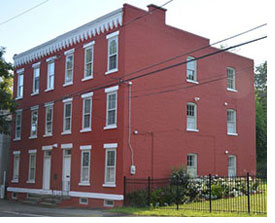
Kate Mullany National Historic Site
Home of the American Labor Studies Center
Jews in the American Labor Movement
“We Were There” video with Bev Grant’s song and historic photos
Interviews with women labor leaders
The American labor movement has a long and rich heritage of song. Like hymns and patriotic songs, union songs are songs with a message. Thousands have been written by union members and others over the years. These men and women, black and white, native American and foreign born, created their own literature reflecting every aspect of life in the mines, mills, factories, shops and farms where they were forced to labor…
History of Women in the Labor Movement “We are starving while we work; we might as well starve while we strike!” — 1909 Garment Workers’ Strike Banner Introduction Women have worked for ages in industrial, clerical, and service work and …
Union Maid A Song by Woody Guthrie © 1961 Ludlow Music Inc. There once was a union maid She never was afraid Of goons and ginks and company finks And the deputy sheriffs who made the raid She went to …
The following are videos available from YouTube on labor history. Please let us know if you are aware of others.
Women and Work – An Introduction
The Face of the Labor Movement – Women at the Front Lines
Suggested Information for Further Research
More resources from the Coalition of Labor Union Women (CLUW)
25 Labor Events and Organizers Who We Should Teach About During Women’s History Month
Union Women Union Power: From the Shopfloor to the Streets
A Guide to Organizing Women’s Committees
Want to Increase Women’s Influence in the Labor Movement? Here’s How
Click here to visit the U.S. Labor and Industrial History World Wide Web Audio Archive from the Department of History at University at Albany, State University of New York.
Click here to read the histories of most American unions
Triangle Factory Fire This web exhibit presents original documents and secondary sources on the Triangle Fire, held by the Cornell University Library. Remembering the Triangle Fire
If You Don’t Come in on Sunday, Don’t Come in on Monday
Newly available award winning documentary of labor history.
-Click here to read the review
-Click here to order a copy of the documentary
Click this link to see New York City Labor History Map.
Click this link to learn about the American Labor Museum Botto House National Landmark
Click here to visit a virtual museum designed to gather, identify and display examples of the cultural and artistic history of working people.
Negro History Week was celebrated for the first time in 1926 during the second week in February. This month was chosen because Frederick Douglass and Abraham Lincoln celebrate their birthdays during the month. In 1976 Negro History Week became Black History Month and the rich history of African Americans began to receive special attention during the entire month of February…
Labor-religion coalitions have become increasingly common throughout the United States. While some may be surprised by this development, most people of faith immediately recognize the natural connection between religious creeds and the mission of organized labor. Both religion and labor…
Cornell University School’s Catherwood Library Reference Staff each Monday through Friday provides abstracts and links to workplace-related news stories covered in the major media.
Reprint of Timothy G. Borden’s annotated list of some of the leading works of the literature of American working-class studies.
Click here to see the list…
A comprehensive list of links to labor-related photos…
Education For Democracy: “Education For Democracy,” is a recent position paper developed by the Albert Shanker Institute that addresses the following: How do we instill in a new generation an understanding of an an appreciation for their stunning political historic?…
Documenting Labor Inside and Out uses the Archives of Public Affairs and Policy, located at the University at Albany New York, to document the lives of working people with material on worker’s culture and social welfare organizations. The digital exhibit, created by Cynthia K. Sauer and Brian Keough, makes many primary resources available while adding instructional elements such as: Who Uses Labor Records? and Labor Culture.
Our Documents is a national initiative on American History, Civics, and Service. It is intended to promote public understanding of how rights and responsibilities have taken shape over time. The National Archives and Records Administration is largely responsible for the project. Click here to learn more.
Photographs of Lewis Hine: Documentation of Child Labor – This “Teaching with Documents Lesson Plan” was developed by the staff at the National Archives & Records Administration. The well developed lesson plan contains a correlation to the National History Standards and the National Standards for Civics and Government. Once at the NARA web site you’ll find many other interesting lessons. (Hine’s Photos @ “The History Place”)
The Employee Free Choice Act, supported by a bipartisan coalition in Congress, would enable working people to bargain for better benefits, wages and working conditions by restoring workers’ freedom to choose for themselves whether to join a union…
Chronology of American Labor History
An extensive resource of research tools including bibliography, biography, materials (texts and journals), organizations, instructional centers, instruction, timelines and labor history maintained by Dr. Lynn Nelson of the Kansas Heritage Group
“Imagine opening a high school U.S. history textbook and finding no mention of —or at most a passing sentence about—Valley Forge, the Missouri Compromise, or the League of Nations…”

This excellent photo-packed 62 page history of unions is for 9 -12 year-old students. Search online to purchase.

The Power in our Hands: A curriculum on the History of Work and Workers in the United States is the single best resource for middle and high school teachers who want to integrate labor history into their classrooms. It is organized into five units and 16 lessons and includes 46 handouts includes a bibliography for each unit. Click HERE to order for $23.00.
Union Communications Services , sponsored by the Worker Institute at Cornell ILR, produces materials, media, context and commentary that worker-leaders can put to use immediately.
Resources for teachers who have a limited amount of time to incorporate labor history into their classrooms.
Traces the history of the labor movement from its beginnings to the late 20th century.
A lesson guide for teachers to accompany "A Short History of American Labor"
A description and order information for two excellent labor history films to supplement "A Short History of American Labor" - If You Don't Come in on Sunday, Don't Come in on Monday and The Inheritance

Home of the American Labor Studies Center
A standards-based curriculum for teachers for grades 5-12 by the 9/11 Tribute Center at the World Trade Center.
A History of Union Banners
