
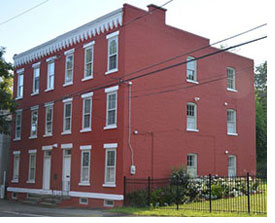
Kate Mullany National Historic Site
Home of the American Labor Studies Center
The 100th Anniversary of the Great Lawrence Strike of 1912, popularly referred to as the Bread & Roses Strike, begins January 2012. A number of events have been planned to commemorate this historically significant event. The Bread and Roses Centennial …
The Empirical Case for Streamlining the NLRB Certification Process: The Role of Date and Unfair Labor Practice Occurrence.
This study by Cornell’s Kate Bronfenbrenner and Columbia’s Dorian Warren examines a proposal
New Data: NLRB Process Fails to Ensure a Fair Vote
This new analysis of NLRB election data reveals how current NLRB procedures…
If You Don’t Come in on Sunday, Don’t Come in on Monday The Review (https://8jc.9e8.mywebsitetransfer.com/pdfs/If-You-Dont-Come-in-on-Sunday.pdf) Order Information Order Online Here (click here to download form) MEI Publishing Inc. 44424 Oriole Dr. #203 Fort Mill, SC 29707-5953 Phone: (718)548-4200 Fax: (718)548-4202 …
The American labor movement has a long and rich heritage of song. Like hymns and patriotic songs, union songs are songs with a message. Thousands have been written by union members and others over the years. These men and women, black and white, native American and foreign born, created their own literature reflecting every aspect of life in the mines, mills, factories, shops and farms where they were forced to labor…
Click here for a variety of labor history lesson plans including ‘United We Stand’ from the Library of Congress
Nearly a decade after Wisconsin passed a law declaring that the teaching of labor history must be part of the teaching standards for the state’s children, it is near to becoming reality.
Workers Independent News (WIN) gathers news by and about working people and creates programs and feature stories for commercial, public, community and college radio stations throughout the United States:
http://www.laborradio.org/

Click here to read about the latest legislation and politics news from AFL-CIO.
Merrimack Films – producer and distributor of videos on labor relations.

(1901-1990)
Melbourne, Australia
Fifteen years after he set foot in San Francisco 1920, Harry Bridges was at the forefront of the International Longshore and Warehouse Union (ILWU), which was the first US union to actively fight against racism. He led the longshoreman’s San Francisco General Strike (May 9, 1934), notable for “Bloody Thursday” and being first industry-wide strike in US history…
Click this link to learn about The History of Labor Day.
Click here to visit a virtual museum designed to gather, identify and display examples of the cultural and artistic history of working people.
Negro History Week was celebrated for the first time in 1926 during the second week in February. This month was chosen because Frederick Douglass and Abraham Lincoln celebrate their birthdays during the month. In 1976 Negro History Week became Black History Month and the rich history of African Americans began to receive special attention during the entire month of February…
A comprehensive list of links to labor-related photos…
The use of quotations can be an effective way to engage students in analyzing different points of view. For example, teachers can provide students with the first two quotations below and ask them to explain the point each person is making and state which, in their opinion, they most agree with and provide evidence for their answer…
The American Labor Studies Center receives numerous inquires from teachers who are interested in
locating a complete course of study on the topic of labor history. Often they hope to have their
school district adopt a version of the course as an elective offering or, at the very least, they
plan to select certain topics for inclusion in a specific course they are already responsible for
teaching…
Documenting Labor Inside and Out uses the Archives of Public Affairs and Policy, located at the University at Albany New York, to document the lives of working people with material on worker’s culture and social welfare organizations. The digital exhibit, created by Cynthia K. Sauer and Brian Keough, makes many primary resources available while adding instructional elements such as: Who Uses Labor Records? and Labor Culture.
Our Documents is a national initiative on American History, Civics, and Service. It is intended to promote public understanding of how rights and responsibilities have taken shape over time. The National Archives and Records Administration is largely responsible for the project. Click here to learn more.
“Using Primary Sources in the Classroom” is a lesson plan developed by the Library of Congress. The lesson’s many suggestions concerning the use of primary resources were developed by Library staff and educators from across the country. The Lessons page, located on this website, contains many examples of labor oriented lessons that focus on the use of primary resources in the classroom.
General Information from the ILO on Child Labor
Cyber School Bus 3Plus-U – An instructional program developed by the ILO to teach about child labor.
Photographs of Lewis Hine: Documentation of Child Labor – This “Teaching with Documents Lesson Plan” was developed by the staff at the National Archives & Records Administration. The well developed lesson plan contains a correlation to the National History Standards and the National Standards for Civics and Government. Once at the NARA web site you’ll find many other interesting lessons. (Hine’s Photos @ “The History Place”)
Free The Children – Children Helping Children –
Free the Children is an international network of children helping children at a local, national and international level through representation, leadership and action. It was founded by Craig Kielburger in 1995, when he was 12 years old.
The Employee Free Choice Act, supported by a bipartisan coalition in Congress, would enable working people to bargain for better benefits, wages and working conditions by restoring workers’ freedom to choose for themselves whether to join a union…
“Imagine opening a high school U.S. history textbook and finding no mention of —or at most a passing sentence about—Valley Forge, the Missouri Compromise, or the League of Nations…”

This excellent photo-packed 62 page history of unions is for 9 -12 year-old students. Search online to purchase.

The Power in our Hands: A curriculum on the History of Work and Workers in the United States is the single best resource for middle and high school teachers who want to integrate labor history into their classrooms. It is organized into five units and 16 lessons and includes 46 handouts includes a bibliography for each unit. Click HERE to order for $23.00.
Union Communications Services , sponsored by the Worker Institute at Cornell ILR, produces materials, media, context and commentary that worker-leaders can put to use immediately.

Resources for teachers who have a limited amount of time to incorporate labor history into their classrooms.
Traces the history of the labor movement from its beginnings to the late 20th century.
A lesson guide for teachers to accompany "A Short History of American Labor"
A description and order information for two excellent labor history films to supplement "A Short History of American Labor" - If You Don't Come in on Sunday, Don't Come in on Monday and The Inheritance

Home of the American Labor Studies Center
A standards-based curriculum for teachers for grades 5-12 by the 9/11 Tribute Center at the World Trade Center.
A History of Union Banners
